Русский
 Français
 بالعربية
 Español
Engineering High-Performance RGBW Lighting for Commercial Aquatic Facilities
Commercial RGBW pool lighting engineering: Successfully deploying underwater lighting in large-scale municipal or resort pools requires moving beyond residential-grade components. By focusing on hardware-level spectral power distribution, advanced thermal management for SMD 3535 chips, and rigorous IP68 potting standards, engineers can minimize long-term system failure and ensure consistent color output across multi-zone installations.
The Engineering Gap: Why Residential RGBW Fails in Commercial Pools
In municipal and high-traffic resort environments, lighting is subjected to constant chemical exposure, high water pressure, and continuous operation cycles that quickly degrade residential-grade products. A common failure point is the ingress of water into the driver housing due to inadequate sealant methods. From manufacturing thousands of units, we have observed that standard silicone gaskets fail when subjected to the pH fluctuations typical of high-chlorine environments. True Led Pool Light integrity requires industrial-grade materials like UV-stabilized ABS and high-grade polycarbonate, rather than lightweight plastics prone to osmotic stress cracking.
Spectral Precision: The Physics of Hardware-Level RGBW Output
The core of professional Sourcing Commercial Rgbw Underwater Pool systems lies in spectral control. While residential systems often rely on software-based blending—which can lead to color drift and inconsistent Color Rendering Indices (CRI)—hardware-level control ensures that the white channel (the 'W' in RGBW) functions independently of the color arrays. By utilizing precision-engineered RGBW chips, we maintain color consistency across long cable runs, avoiding the 'color ghosting' that occurs when individual diode wavelengths drift due to thermal expansion.
Thermal Management & Driver Reliability
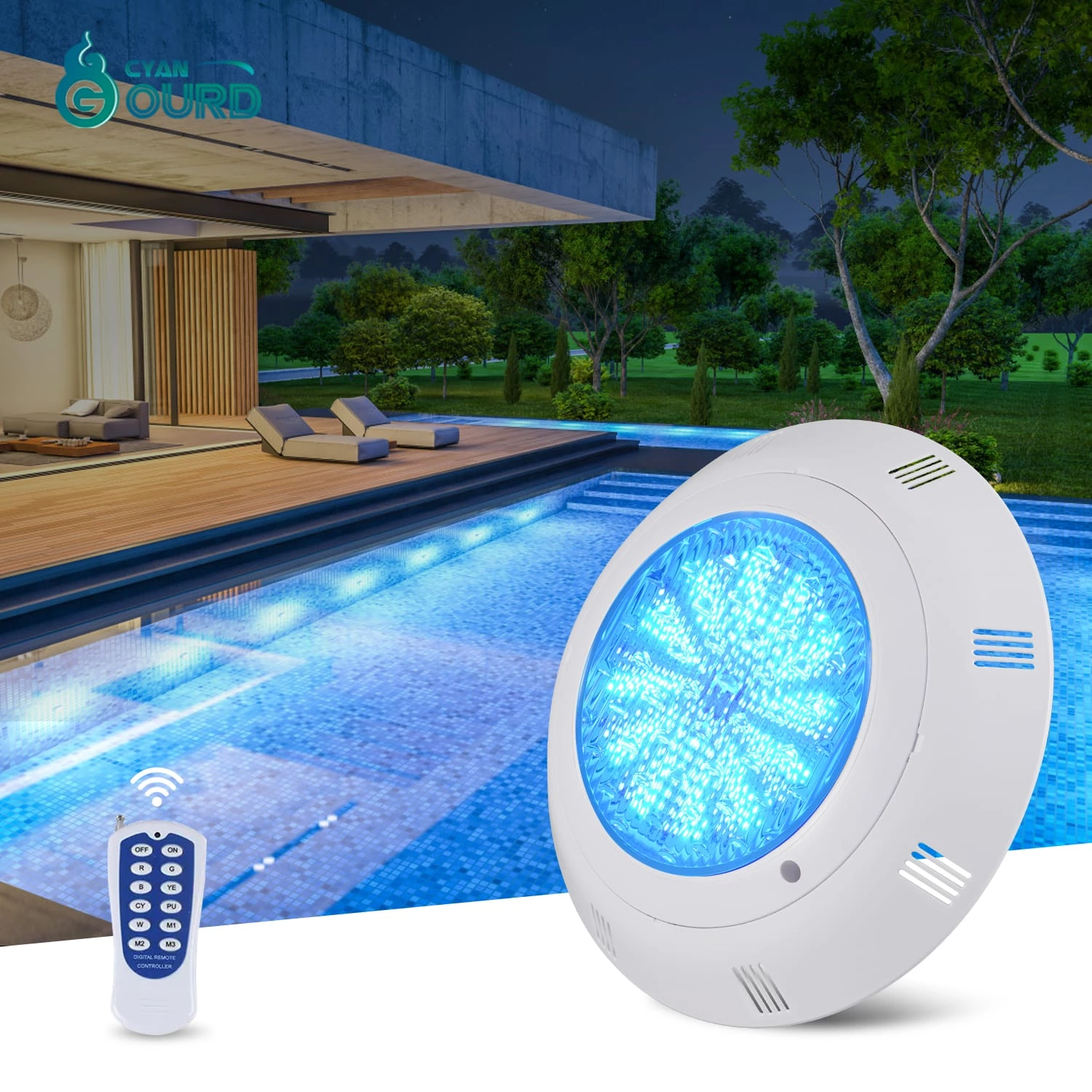
Driver longevity is inextricably linked to thermal management. In enclosed underwater housings, heat accumulation is the primary driver of premature LED failure. Our Nicheless Pool Light series, specifically the QR-55 model, utilizes high-conductivity thermal substrates to dissipate heat away from the SMD 3535 source. Measuring just φ55*H110mm, the QR-55 is designed for confined spaces where passive cooling is difficult. We utilize factory-conducted accelerated aging tests—subjecting drivers to 1000+ hours of continuous, high-temperature chlorine immersion—to validate that the driver components remain within tolerance thresholds, documented according to standard LM-80 protocols.
Manufacturing Integrity: Ingress Protection Standards
Our manufacturing process includes a critical QC checkpoint: vacuum-sealed, multi-stage potting. Unlike simple gasket-based seals, our proprietary epoxy resin potting fills every micro-void inside the housing, effectively making the electronics impervious to moisture even if the outer lens integrity is compromised. We adhere strictly to IP68 test protocols, certifying each batch against water ingress at depths exceeding 2 meters. These measures are essential when engineering Commercial Led Pool Systems Light for public aquatic facilities.
Selecting the Right Optic: Comparing Embedded vs. Nicheless Systems
Selecting between Embedded Pool Light systems and surface-mounted nicheless units depends on the architectural constraints of the pool shell. Below is a comparison of technical considerations for procurement.
| Feature | Embedded Systems (e.g., QR290) | Nicheless Systems (e.g., QR-55) |
|---|---|---|
| Installation Type | Recessed / Flush mount | Surface mount |
| Heat Dissipation | Convection via pool water | Integrated aluminum heat sink |
| Best Use Case | Large municipal lap pools | Retrofits & Resort aesthetics |
Need Technical Validation?
Request our comprehensive spec sheet and accelerated aging test reports for the QR-55 and QR290 series.
Request Technical DataCompliance Framework: Meeting Electrical Safety Standards
All underwater installations must comply with IEC 60598-2-18 standards for luminaires used in swimming pools. This requires that every light fixture maintains low-voltage (typically 12V or 24V DC) operation and that the casing provides robust galvanic isolation. Our engineering team designs specifically to meet UL 2108 low-voltage lighting safety mandates, ensuring that even in the event of a lens breach, the system prevents potential electrical hazards to swimmers.
Procurement Strategy: Evaluating Long-Term ROI
For MEP contractors, evaluating lighting based on unit cost alone is a fiscal risk. Maintenance cycles for high-output aquatic lighting are costly, often requiring site drainage or diver intervention. By specifying hardware designed for thermal stability and moisture ingress resistance, projects can extend maintenance intervals from 2 years to 5+ years. When reviewing Commercial Pool Control Systems Light, always request documentation of driver longevity testing under chemical-heavy conditions.
Frequently Asked Questions
Q: How does hardware-level RGBW color mixing improve commercial pool aesthetics?
A: Hardware-level mixing ensures that each diode (Red, Green, Blue, White) is driven by independent PWM circuits, preventing color-shift common in software-blended systems. This results in consistent saturation and precise white temperatures for safety.
Q: What is the importance of IP68 certification for aquatic lights?
A: IP68 certification confirms that the fixture is protected against complete, continuous submersion in water under pressure, which is critical for preventing electrolytic corrosion and internal circuit failure.
Q: Why is thermal management critical for SMD 3535 LEDs?
A: The SMD 3535 is a high-intensity chip that produces significant heat. Effective thermal conductivity in the housing prevents the LED junction temperature from exceeding maximum ratings, which would otherwise lead to rapid lumen depreciation.
Q: Can I connect RGBW lights to my existing building automation system?
A: Compatibility depends on the PWM frequency and DMX/RDM protocol support. Always verify the voltage and signal protocol requirements with your lighting manufacturer before procurement to ensure proper integration.
Q: How do I verify if a manufacturer uses effective potting techniques?
A: Ask for factory-conducted accelerated aging test reports and cross-section samples that demonstrate the resin penetration into the housing, ensuring no air pockets remain around the electronics.
Speak to an Engineering Consultant
Discuss your next commercial aquatic project and receive a custom specification comparison.
Contact Our Engineering Team