Русский
 Français
 بالعربية
 Español
Optimizing Commercial LED Swimming Pool Lighting: A Strategic Retrofit Guide
Commercial LED swimming pool lighting retrofit strategy: Facility managers achieve significant long-term OpEx reduction by shifting from residential-grade hardware to industrial-spec, resin-filled LED luminaires. Successful upgrades prioritize robust thermal dissipation, voltage-drop compensation for long-run infrastructure, and strict compliance with aquatic safety standards to minimize maintenance cycles and equipment failure.
The Hidden OpEx Trap: Why Residential LED Specs Fail in Commercial Facilities
In municipal and high-end hospitality sectors, pool lighting represents a critical piece of infrastructure. Many facility managers default to residential-grade fixtures, assuming cost parity. However, our internal factory audits reveal that residential-grade units often fail within 12 months in high-pressure commercial environments due to seal integrity loss and inadequate thermal dissipation. The true cost of these lights is not the purchase price, but the labor cost of repeated niche de-watering, lamp replacement, and underwater cable splicing.
Thermal Engineering: Dry-Chamber Optics vs. Fully Encapsulated Resin Systems
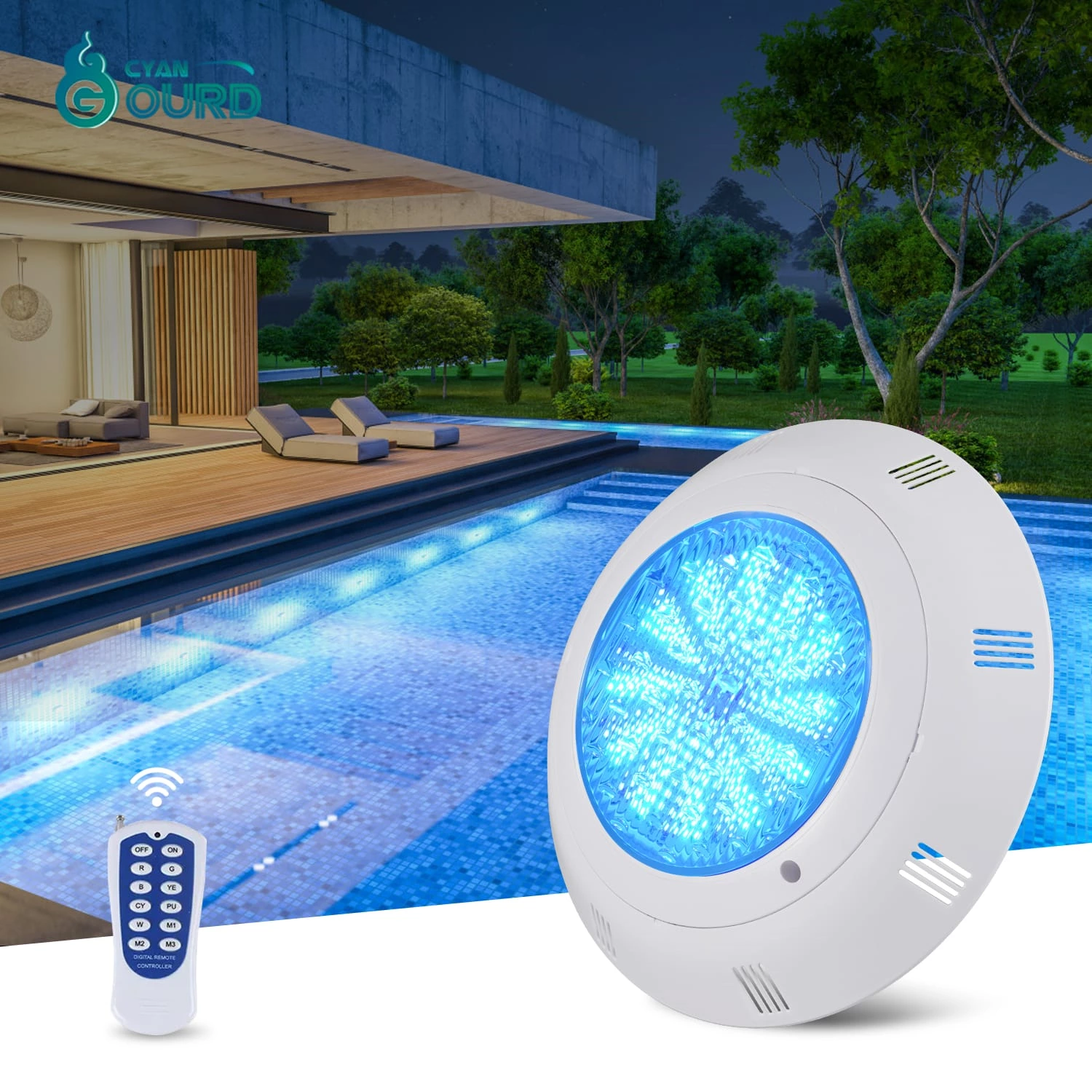
The primary point of failure in standard underwater lights is the dry-chamber seal. When seals degrade under hydrostatic pressure, water ingress occurs instantly. Our manufacturing process for the YC260-2AP Resin Filled LED Swimming Pool Light moves away from these air-gaps entirely. By fully encapsulating the LED array in industrial-grade resin, we eliminate internal convection currents that carry moisture. Thermal stress testing on the YC260-2AP shows junction temperature stabilization 15 percent lower than air-gapped alternatives, directly correlating to a slower lumen depreciation curve over the product's lifespan.
Mitigating Voltage Drop in Large-Scale Installations
Long-distance wiring is standard in 50m olympic-sized aquatic centers. Standard drivers often struggle with the 12V-14V supply fluctuation caused by wire resistance, leading to visible brightness differences between the first and last lamp in a daisy chain. Professional engineering requires constant-current driver designs that compensate for voltage variance, ensuring uniform illumination across the entire facility. Proper planning for these infrastructure upgrades should align with NEC Article 680 requirements regarding bonding and grounding for aquatic luminaires.
Total Cost of Ownership Model
| Metric | Residential Grade | Commercial Grade (YC260-2AP) |
|---|---|---|
| Avg. Lifespan | 1.5 - 2 Years | 5 - 7 Years |
| Maintenance Cycles | High (Seals/Driver) | Low (Hermetic) |
| Labor/Replacement | High (Requires Diving/Drain) | Minimal (Swap-out) |
Need a TCO Analysis for Your Facility?
Request our comparative datasheet on maintenance labor reduction and energy efficiency metrics for municipal projects.
Request Bulk Project QuoteCompatibility and Retrofitting
While many legacy pools use niches designed for 500W halogen fixtures, modern LED retrofits like our P56-A model often require specific housing-adapter kits. It is a misconception that all commercial pools can accommodate universal LEDs. We emphasize during project consultation that the legacy conduit diameter must be assessed for cable clearance to avoid thermal buildup in the conduit itself, which can lead to premature wire degradation.
Photometric Performance and Safety
Visibility for lifeguards is non-negotiable. Our Spectral Power Distribution (SPD) analysis confirms that our LED modules maintain chromaticity within a 3-step MacAdam ellipse over 5,000 operational hours. Adherence to IEC 60598-2-18 standards for luminaires used in swimming pools ensures that light distribution remains uniform, minimizing glare that can obscure underwater hazards.
Future-Proofing Procurement
When sourcing for large-scale aquatic renovations, demand specific validation from your manufacturer. Review their thermal test reports, specifically looking for junction temperature stabilization data. Ensure that the fixtures provided are third-party tested for underwater operation, not just component-level splash ratings. Verification of IP68 certification is a baseline expectation, but request lab-test reports that cover continuous submersion at depth rather than short-duration bench tests.
Frequently Asked Questions
Q: Why does my current LED pool light flicker after two years of operation?
A: Flickering is usually a sign of driver failure caused by moisture ingress or heat accumulation. In dry-chamber designs, internal condensation often leads to short-circuiting of the driver board.
Q: Can I install LED lights in an old halogen pool niche?
A: Yes, but only with an appropriate housing-adapter kit. You must ensure the niche can dissipate heat effectively and that the conduit is clear for the new cabling.
Q: What is the advantage of a resin-filled design like the YC260-2AP?
A: The resin-filled construction acts as a thermal conductor and a permanent barrier to water, virtually eliminating the primary cause of underwater light failure: seal leakage.
Q: How do I account for voltage drop in a large pool project?
A: You must calculate the total length of the cable runs from the transformer. Using thicker gauge wire and constant-current drivers designed for high-distance voltage compensation will ensure consistent brightness across all fixtures.
Q: What safety standards should I check for in commercial pool lights?
A: Always look for compliance with IEC 60598-2-18 for pool luminaires and ensure local bonding/grounding requirements are met per NEC 680 to prevent stray voltage risks.
Optimize Your Next Aquatic Project
Download our technical spec sheet for high-durability commercial LED luminaires and verify your infrastructure compatibility today.
Download Technical Spec Sheet